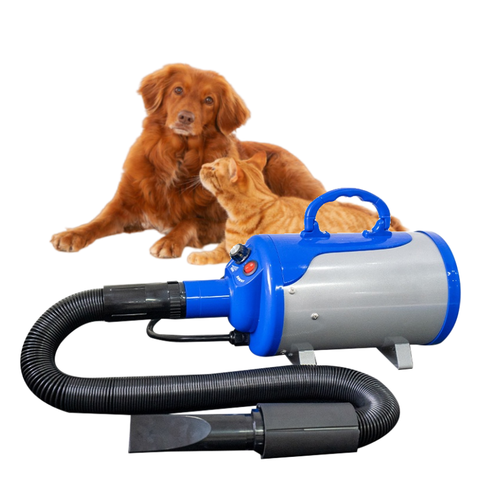
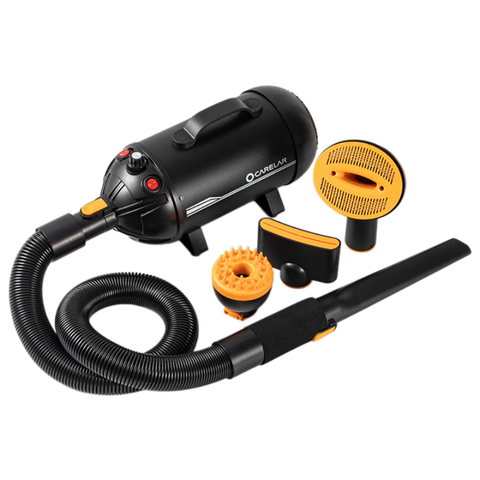
The two drying formats we supply
A blower moves high-volume air at speed and is the tool professional groomers reach for on double coats, thick undercoat and large breeds. The stepless-speed model in this line lets the operator dial airflow continuously rather than stepping between fixed settings — useful when the same tool has to handle a Newfoundland and a Chihuahua on the same afternoon.
A dryer is the quiet, lower-velocity option for cats, rabbits and anxious or elderly dogs. Our brushless-motor model is built specifically for that job: the motor design removes the brush wear and the high-pitched whine that causes most pets to panic, and the softer airflow lets you work close to sensitive skin without blasting the coat.
The numbers that predict how a dryer performs
Product listings often lead with wattage, which is the least useful figure on the page. Ask for these instead:
| Field | What to pin down |
|---|---|
| Airflow (m³/h or CFM) | The strongest single predictor of drying speed. A well-designed 2000W blower can outperform a poorly designed 2800W unit. |
| Noise level (dB, at stated distance) | Insist on the measurement distance — 70 dB at 1 m is a quiet machine, but the same figure quoted at 3 m is not. Below roughly 75 dB is the threshold most pet retailers advertise as quiet. |
| Motor type | Brushless motors last longer, run cooler and are quieter. Brushed motors are cheaper and wear out; the difference shows up in warranty claims, not in the catalogue photo. |
| Heat control | A separate heating element with stepless or stepped control, and a safety cut-out. Uncontrolled heat damages coat and skin and is a genuine product-liability exposure. |
| Hose and nozzle set | Diameter and length determine reach and back pressure. Round, flat and concentrator nozzles are the standard set; more nozzles sell better at retail. |
| Housing and grip | ABS or PP housing, rubberised grip, and a hose that does not kink. Filter design decides how often the unit overheats in daily salon use. |
Voltage, plugs and certification by market
- North America: 110–120V / 60Hz with a Type A or B plug. Buyers increasingly expect a UL or ETL listing for anything mains-powered — plan for the cost if you intend to sell through retail chains rather than online.
- UK: 220–240V / 50Hz, Type G plug, UKCA marking. Great Britain continues to recognise CE marking for most goods, but for a new product placed on the GB market we build and mark to the current UK requirement.
- EU: 220–240V / 50Hz, Type C or F plug, CE marking with an EU Declaration of Conformity. Electrical safety testing is a factory obligation, not something to arrange after import.
- Australia and New Zealand: 230–240V / 50Hz, Type I plug, RCM marking.
What a pre-shipment check looks like on powered goods
Mains-powered equipment gets a different inspection routine from textile goods. We run a power-on test and check noise against the agreed figure on sampled units, verify the plug and voltage configuration against the order sheet, confirm the rating label matches the destination market, and check that the motor does not overheat during a sustained run.
Cartons for powered goods carry a higher drop risk because of the weight, so we specify reinforced corner protection and a foam insert that holds the unit clear of the walls. If you are selling online, ask for the drop-test result for the retail carton — it is the cheapest way to reduce transit damage claims.
Related supply lines
Buyers sourcing grooming & drying usually build a mixed order across Clippers & Trimmers · Pet Cleaning Supplies · Pet Strollers — all of which can ship together in one consolidated consignment.